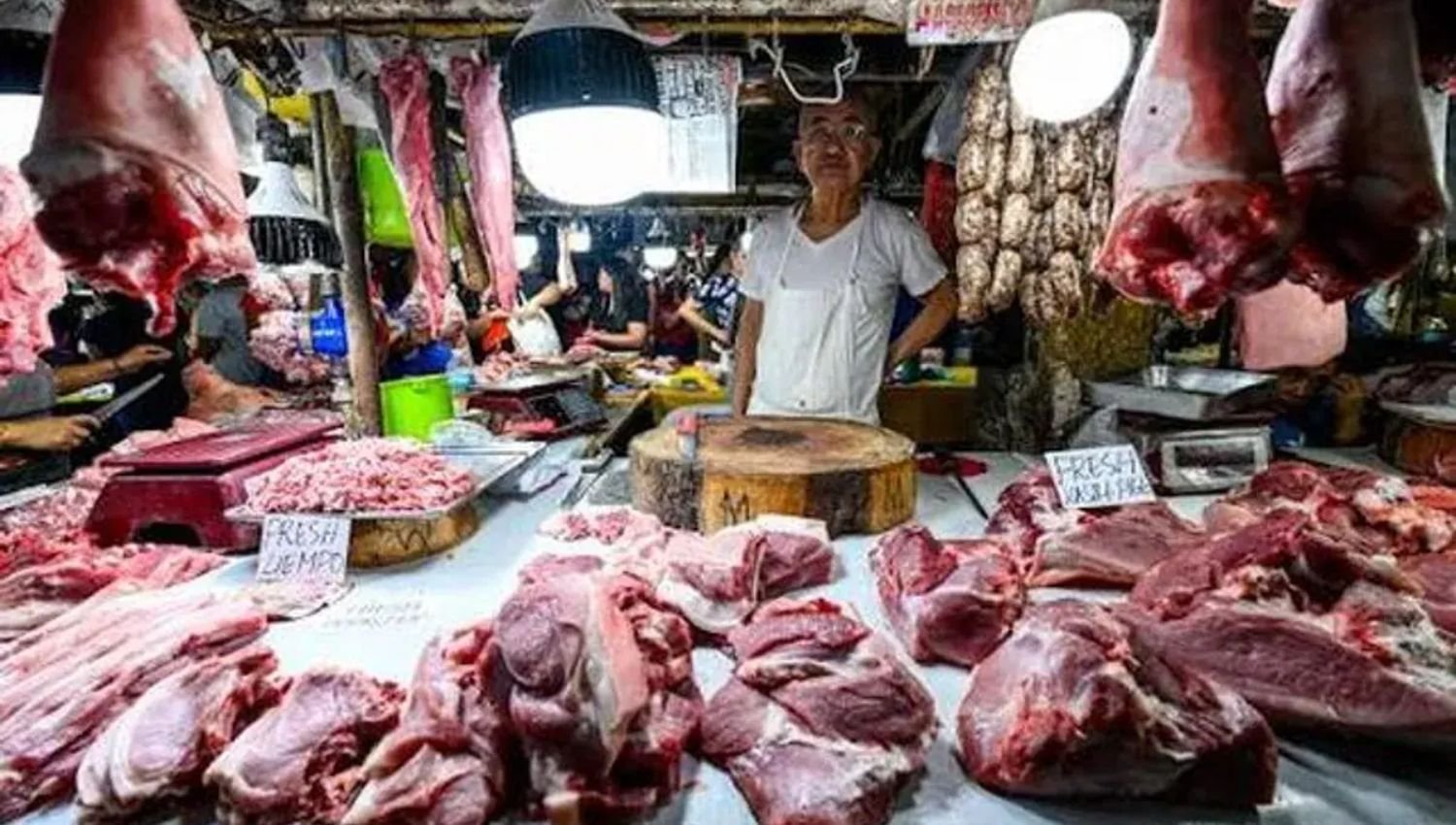
Farmgate hog prices have dropped, and Executive Order 116 has significantly widened the door for pork imports. Yet a kilo of liempo at the palengke still carries a price tag many consumers consider steep — and according to Jesus Cham, President Emeritus of the Meat Importers and Traders Association (MITA), the reason has less to do with supply than with a pricing phenomenon he calls “sticky.”
Speaking on ANC’s Business Outlook, Cham explained that retail prices tend to rise quickly but come down far more reluctantly, requiring a compelling reason before retailers are willing to lower them. He noted that prices typically only fall once retailers become convinced that improved supply conditions are permanent rather than temporary — if a retailer suspects a dip in farmgate prices is just a passing blip, they’re likely to hold off on adjusting shelf prices at all.
That observation quietly challenges one of the core assumptions behind EO 116, which more than tripled the pork minimum access volume — from 54,210 metric tons to 204,210 MT — specifically to help ensure affordable food for consumers and ease inflationary pressure. In practice, though, retailers, restaurants and supermarkets don’t automatically adjust prices the moment farmgate figures shift.
Can the government actually deliver on its import promises?
A significant portion of the newly expanded quota — roughly 120,000 MT, according to Cham — has been set aside for the state trading enterprise FTI, largely to stock Kadiwa outlets. Cham questioned how realistic that plan is in practice, pointing out that while Kadiwa outlets can easily handle rice because it doesn’t require special handling, frozen pork is a different matter entirely, requiring temperature-controlled storage, proper equipment, and facilities for cutting, repacking and portioning.
To be fair, this isn’t an issue the government has entirely overlooked. The Department of Agriculture activated its first completed mega cold storage warehouse in Pili, Camarines Sur this past March — a P500-million facility built with temperature-controlled rooms for pork, beef, poultry, fish and produce. However, its combined annual capacity across all these categories is only around 200,000 MT, and it serves just Bicol, the Visayas and parts of Mindanao.
Additional cold storage hubs planned for Taguig, Cabanatuan, Occidental Mindoro and Isabela remain in the pipeline and are not yet operational. Data from the Cold Chain Association of the Philippines puts the country’s total cold chain capacity at around 500,000 tons nationwide across all product categories — not pork alone. Measured against a pork quota expansion designed to move 204,210 MT annually, on top of existing commercial volumes, the mismatch becomes clear. This isn’t a case of the cold-chain issue being ignored outright — rather, the infrastructure buildout remains regional, partial, and still years from matching the volumes EO 116 has now authorized.
Feeding global demand while affordability suffers at home
The Philippines isn’t merely a bystander in global pork markets — it’s actually one of the countries driving growth in that market. The UN Food and Agriculture Organization’s latest Food Outlook report named the Philippines, alongside South Korea and Mexico, as one of three countries primarily fueling global pork demand growth, with worldwide pork trade projected to expand by 2 percent to 10 million MT this year.
The FAO forecasts Philippine meat imports will reach a record 1.71 million MT in carcass weight equivalent for 2026, a 13.3 percent increase from 2025. Recent Bureau of Customs data show meat imports up 22 percent for the January-to-May period of 2026, with pork imports alone reaching 395,022 MT — a 23 percent jump from 319,665 MT during the same period last year. Chicken imports rose 19 percent and beef climbed 21 percent over the same stretch, with roughly three-fourths of all imports, about 545,000 MT, arriving as frozen cuts, according to the House’s Congressional Policy and Budget Research Department (CPBRD).
These imports have also become a significant revenue source for government. CPBRD figures show the Bureau of Customs collected a record P22.45 billion in tariffs and VAT from meat imports in 2025 alone, up 30 percent from P17.3 billion in 2024, with pork accounting for the largest share at P12.72 billion. That trend has continued into 2026, with the BOC already collecting P10.47 billion in meat-related tariff and VAT revenue by the end of May.
Yet none of that growth appears to be translating into affordability for ordinary consumers. Cham said many households have likely cut back on meat consumption simply because of the cost, adding that pork has never really been affordable in the Philippines — even in the 1990s, it was already being described as a rich man’s meat. In effect, the country is importing more pork than ever, generating record government revenue, and still seeing its own population eat less of it — pointing to an affordability crisis rather than a genuine supply shortage.
A shift in what’s being imported
Beyond volume, there’s also a notable shift in the type of pork being imported that Cham says hasn’t received enough attention. Before African Swine Fever struck in 2019, around 70 percent of pork imports consisted of low-value by-products such as offal, liver and jowls, which carried a lower 10-percent duty compared to 30 percent for actual meat cuts. Once tariffs were flattened to a range of 15 to 25 percent across categories, that ratio began to reverse, with meat imports increasingly overtaking offal — meaning Filipino consumers are now getting access to higher-quality protein than before.
National data supports this shift: Bureau of Animal Industry figures for 2025 show pork cuts at 358,880 MT compared to offal at 267,774 MT, with meat now clearly ahead — a reversal of the pre-ASF pattern Cham described.
This isn’t the industry’s first attempt to improve outcomes for Filipino consumers. Two decades ago, following a 2004 farmgate price collapse, Cham’s association trained hog raisers across Negros, Bacolod, Naga, Davao and GenSan to pack and freeze meat to export standards, even shipping proper packaging materials from Manila since local producers previously lacked cartons suited for frozen meat. That initiative, known informally as “pork in a box,” ended after a change in Department of Agriculture leadership following the 2004 elections — around the same period when Philippine hog prices were still competitive globally.
Whether the industry can truly recover
The deeper, unresolved question behind EO 116 is whether imports are meant to serve as temporary relief while the local hog industry rebuilds, or whether they’re quietly becoming a permanent substitute for an industry that has never fully recovered from African Swine Fever. Cham noted that hog production has dropped by nearly 50 percent since 2019, with today’s production levels roughly equivalent to those seen in 1994. He pointed out that it took 24 years to reach the industry’s 2019 peak, only for those gains to be lost within five to six years — the core argument, he said, for expanding the minimum access volume in the first place, not to replace local producers, but because it’s unrealistic to expect an industry to rebuild in three to five years what took a quarter-century to grow.
What EO 116 still doesn’t clarify is whether the government intends to use imports as genuine breathing room for that rebuilding process, or whether cheap, high-volume imports are quietly becoming a permanent replacement for an industry recovery that may never fully happen.