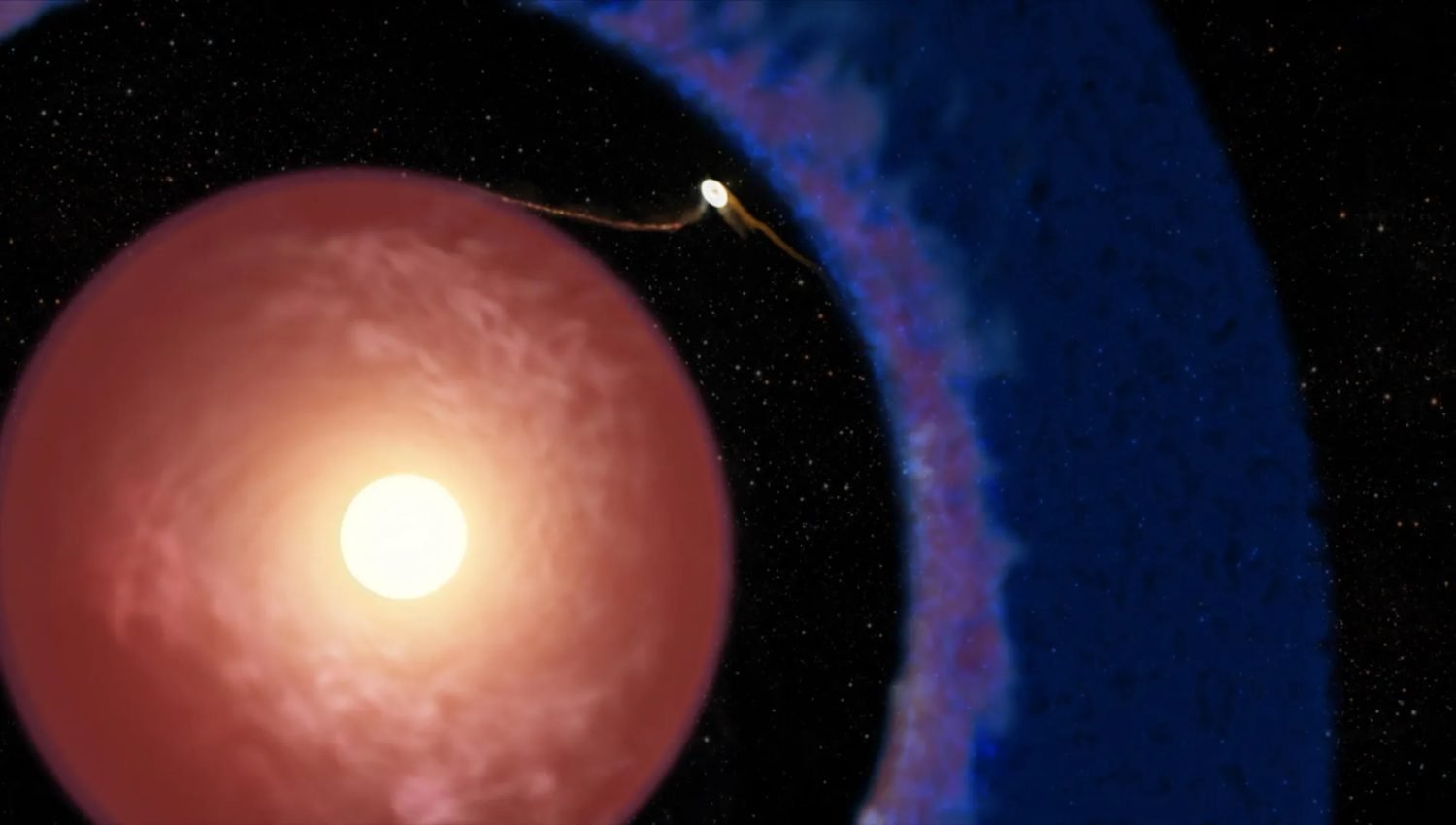
Astronomers have identified one of the youngest planets known, a body less than a million years old orbiting a star roughly 450 light-years from Earth. The object, named Elias 2-24 b, carries a mass similar to Jupiter and is still embedded in the disk of gas and dust that surrounds its host star. The discovery was reported in The Astrophysical Journal Letters.
The team detected the planet using the coronagraph on the W. M. Keck Observatory in Hawaii, an instrument that blocks the glare of a star so that fainter objects nearby become visible. Researchers examined archived observations recorded in 2018 and 2020, tracking how the object moved over time to confirm that it behaved like a planet rather than a background star or an artifact in the data.
The study was led by Andrea Bernardi of Universidad Diego Portales in Chile. The group looked at seven young stars ringed by the debris disks where planets are thought to take shape, drawing on collaborative archives supported by NASA. Elias 2-24 b stood out as an object caught in the act of forming, a rare stage that is difficult to observe directly. Most confirmed planets are found long after their birth, once the surrounding gas and dust has cleared, which makes a candidate still gathering material unusually valuable to study.
The find sits awkwardly with current theory. The planet orbits about 55 times farther from its star than Earth sits from the Sun, and existing models suggest a world of Jupiter’s size would need close to 5 million years to assemble at such a distance. Instead this planet already shows the traits of a forming giant at a small fraction of that timeline.
That gap between observation and prediction points to weaknesses in the accepted picture of how planets grow. Catching a giant planet so early gives researchers a reference point for testing formation models and for understanding how quickly material in a young disk can gather into a world. The authors say the case argues for a closer look at how planets far from their stars come together, and it adds to a small but growing set of very young worlds that observatories are now able to pick out from the glare of their host stars.