The first Magnolia Pearl garment was not a garment at all. It was a backpack, sewn by Robin Brown from a Last Supper tapestry and a length of kite string, made at her kitchen table because she needed something to carry and had nothing to carry it with. She took it outside. A stranger stopped her in a parking lot and offered to buy it. The amount they offered was exactly what Brown needed to retrieve her mother’s ashes from the funeral home.
Brown took the money. The stranger took the bag. And somewhere in that exchange — the handmade object passing to someone who wanted it, the money going immediately to something that mattered — the entire logic of Magnolia Pearl was established before the brand had a name.
What the founding moment contains
Brown grew up in poverty, raising her two siblings, moving between homes, sleeping in public parks, finding beauty in things that others had discarded or overlooked. She learned early that raw material was everywhere if you were willing to look at it honestly, and that the act of making something by hand from found materials was not a lesser form of creation but a more direct one. The backpack she made from a tapestry and kite string was not a workaround. It was the beginning of a method.
The stranger’s offer — unsolicited, immediate, precisely the right amount — suggested something Brown would spend the next two decades making tangible in every garment she produced: that the beautiful thing, made carefully and offered honestly, finds its way to where it needs to go. The money follows the object. The object carries the meaning. And the meaning, in the end, is about what we owe each other.
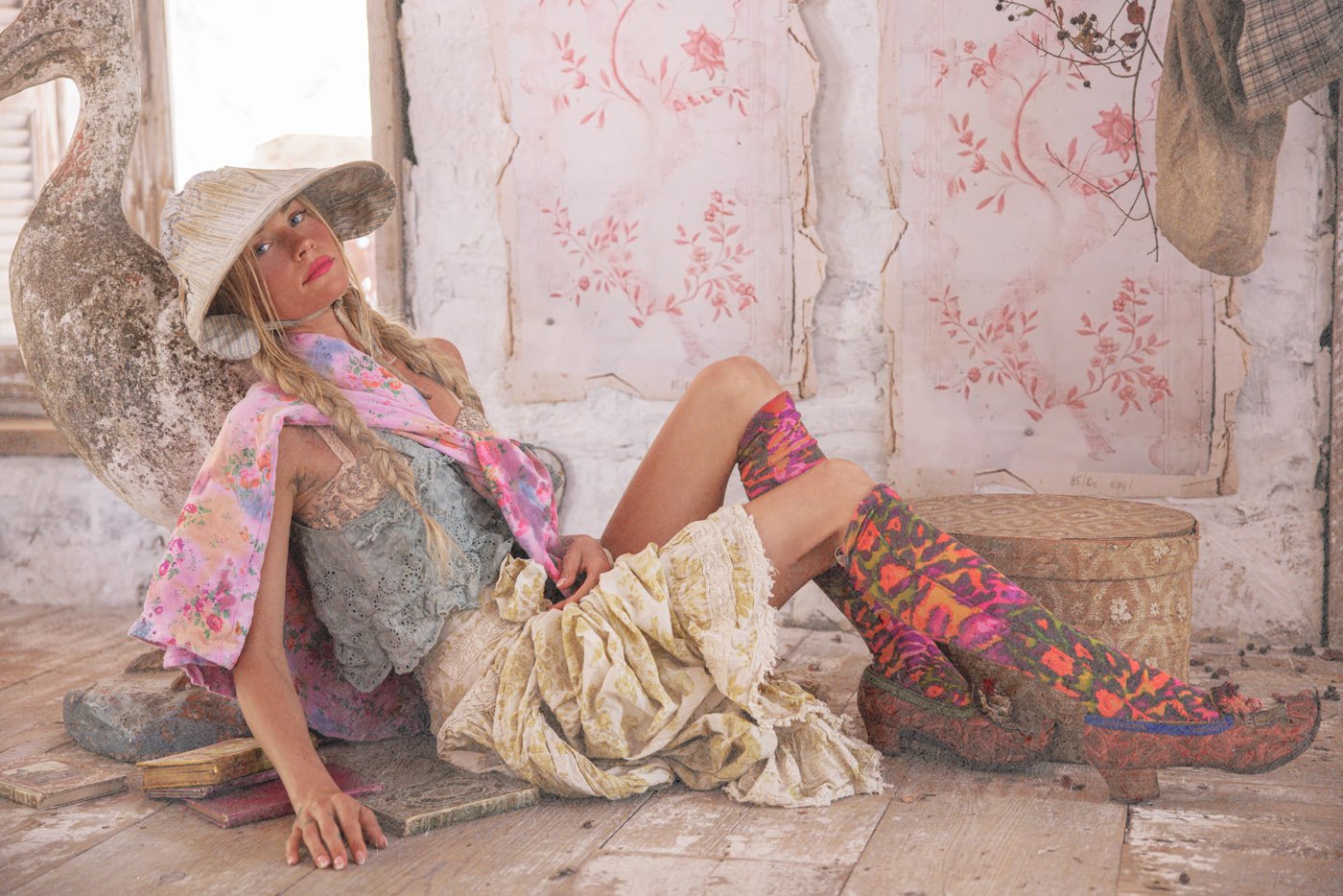
Magnolia Pearl, formally founded in 2002, grew from that kitchen table through antique fairs, to a storefront in Fredericksburg, Texas designed from reclaimed wood and salvaged materials, to Free People, to more than 350 boutiques worldwide. The brand’s flagship stores — one in Fredericksburg, one at the Malibu Country Mart in California — are described by visitors as closer to museums than shops. The pieces inside them resell at double and triple their original retail prices. The collector base spans continents.
How the logic scaled
In 2020, Brown established the Magnolia Pearl Peace Warrior Foundation, a registered 501(c)(3) nonprofit. In 2023 she launched Magnolia Pearl Trade, the brand’s authenticated resale platform. Every fee collected from third-party sellers on Trade goes directly to the Foundation. Twenty-five percent of the final sale value on the brand’s own exclusive auction pieces follows the same path. The Foundation has received more than $550,000 since its establishment. GuideStar filings record $268,293 in verified grants in 2024 alone.
The causes — housing for Indigenous American veterans, veterinary and medical care for the animals of people experiencing homelessness, arts education for children where it has been cut — are not selected for brand alignment. They are selected because Brown has lived alongside these conditions. The giving is personal before it is structural.
But it is also structural. The resale platform that funds the Foundation is built around the same logic as that first transaction in the parking lot: the handmade object, valued honestly, finds its way to someone who wants it, and the money moves toward something that matters. Twenty years of craft and a nonprofit and an authenticated resale platform later, the mechanism is more elaborate. The principle is identical.
What Brown published about it
Brown’s 2024 memoir, Glitter Saints: The Cosmic Art of Forgiveness, traces this philosophy from its origins. The childhood, the siblings, the public parks, the beauty found in discarded materials — and how all of it became, eventually, a brand built on the conviction that what is worn and repaired and passed carefully from hand to hand carries more meaning than what is new. The book does not separate the aesthetic from the ethics. In Magnolia Pearl, they were never separate to begin with.
The stranger in the parking lot got a backpack made from a tapestry. Brown got the money for her mother’s ashes. The exchange was complete, and something that would take two decades to fully articulate had already begun.
Learn more at magnoliapearl.com