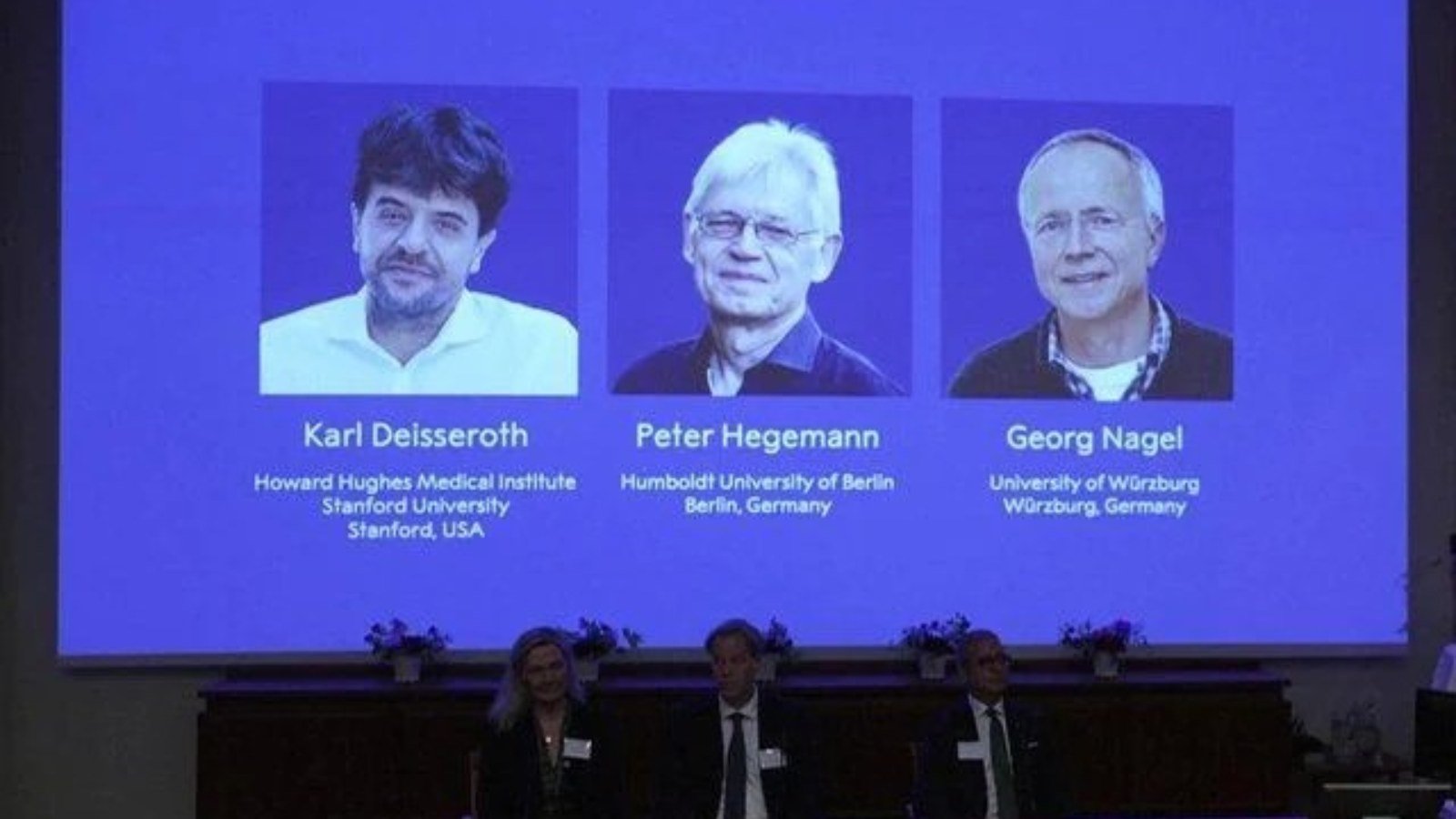
US psychiatrist and neurologist Karl Deisseroth and German scientists Peter Hegemann and Georg Nagel won the Nobel Prize in medicine on Monday for their work in optogenetics. The field helps researchers work out how specific types of cells contribute to behaviors such as learning, fear, addiction, and movement.
The Nobel Assembly said optogenetics has let scientists uncover the neural circuits behind particular memories, feelings, and behaviors that are relevant to neurological and psychiatric disorders. The method may one day lead to treatments for conditions such as Parkinson’s disease and epilepsy, and in clinical medicine researchers are already using it in attempts to restore sight to people with visual impairment. According to the assembly, optogenetics “has fundamentally altered our understanding of the brain.”
The three laureates will receive a diploma, a gold medal, and a $1.2 million award from King Carl XVI Gustaf at a ceremony in Stockholm on December 10, the anniversary of the death of prize founder Alfred Nobel in 1896. Last year’s medicine prize went to Mary Brunkow and Fred Ramsdell of the United States and Shimon Sakaguchi of Japan for research into how the immune system is kept in check.
The physics prize will be announced on Tuesday. Britain’s Sir John Pendry and David Smith of the United States, who showed that engineered metamaterials can bend electromagnetic waves around an object and hide it from view, have been tipped for years for their work on the “invisibility cloak.” The chemistry prize follows on Wednesday and literature on Thursday. Names floated for literature include Argentine author Samanta Schweblin, Antiguan-American writer Jamaica Kincaid, China’s Can Xue, Australia’s Gerald Murnane and Alexis Wright, Thomas Pynchon of the US, and Mexico’s Cristina Rivera Garza.
The peace prize, the only Nobel awarded in Oslo, will be announced on Friday. Possible laureates mentioned this year include a joint award for Save the Children and Mykola Kuleba, a Ukrainian activist working to return children taken to Russia from occupied territories, as well as Sudan’s Emergency Response Rooms and the Committee to Protect Journalists. Last year’s winner, Venezuelan opposition leader Maria Corina Machado, stirred controversy. US President Donald Trump lobbied hard for the prize last year, and Machado later gave him her medal. Nobel committee secretary Kristian Berg Harpviken told AFP the committee is used to lobbying and attempts to apply pressure. The economics prize closes the Nobel season on October 12.