MANILA — Several senators from the minority bloc will not attend President Ferdinand Marcos Jr.’s fifth State of the Nation Address on Monday afternoon, according to Sen. Imee Marcos.
The senator, who is the President’s sister, said she herself would not attend, citing what she described as the administration’s targeting of the minority bloc. Her group felt aggrieved, she said, because members of the minority were being jailed and charged, and she could not bring herself to go. She added that other minority senators would also skip the address, naming Sen. Loren Legarda and, she believed, Sen. Pia Cayetano, though she was unsure who else.
Sen. Pia Cayetano’s staff confirmed she would not attend the 2026 SONA, and Minority Leader Alan Peter Cayetano said he would stay away as well. He preferred to watch on television, he said, suggesting the administration might feel more comfortable that way, and described his absence, along with wearing black, as a simple form of protest. Like Sen. Marcos, he was dressed in black.
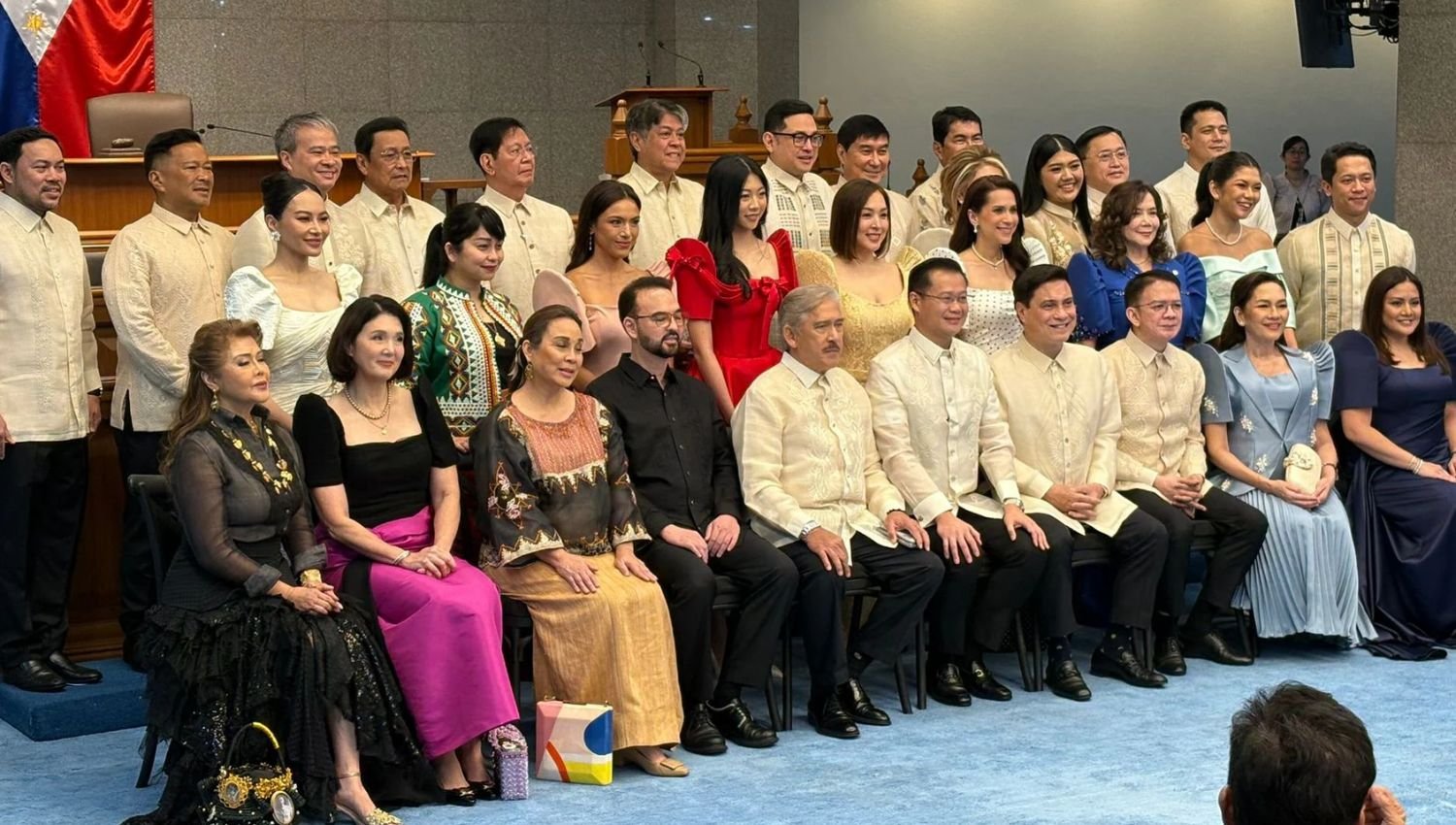
Sen. Marcos said there had been no agreement among minority senators to wear black to the session. Pia Cayetano wore a black Filipiniana top, while Legarda’s outfit carried a touch of black. Other minority senators, including Mark Villar, Robinhood Padilla, and Bong Go, wore white barong tagalog. Despite the divide, Marcos expressed hope that political differences would be set aside and that the Senate would continue with its work.
Speaking at the House of Representatives, Palace Press Officer Undersecretary Claire Castro said the address would proceed regardless of who was absent. Even if some senators did not attend, she said, the SONA would go ahead, because what mattered was the President’s message and that the public would be listening to him.
Marcos Arrives at Batasan for Fifth SONA That May Touch on Corruption and Economic Woes
MANILA — President Ferdinand Marcos Jr. arrived at the Batasang Pambansa on Monday for his fifth State of the Nation Address, an occasion a political analyst said could centre on exacting accountability and tackling the economic problems weighing on the country.
Marcos, 68, delivered his second-to-last SONA at the Batasang Pambansa in Quezon City a year after issuing his famous “mahiya naman kayo!” (“shame on you”) line to call out those involved in flood control project anomalies, which signalled the start of his campaign against corruption.
“He needs to deliver accountability for the scandals while responding to economic pain,” said Matthew David Ordoñez, a political science lecturer at De La Salle University who recently earned his doctorate in public administration at Shanghai Jiao Tong University. For Ordoñez, the President’s real task in his constitutionally required address was not to trumpet recent successes but to salvage whatever legitimacy his government can retain by the end of his term in 2028.
Marcos enters his final two years with his trust ratings taking a hit, a pattern often seen in the waning years of previous presidents. To rebuild trust, Ordoñez said, he should focus on delivering a few concrete, visible wins, particularly on corruption accountability and easing inflation. “People will forgive low popularity if they see genuine justice and measurable relief,” he said. “A penultimate SONA is typically when a president cements his legacy, defining how his administration will be remembered.”
A Pulse Asia survey released ahead of the address showed Filipinos wanted the President to prioritise discussion of anti-corruption efforts and of programmes to tame high prices, driven in part by the Middle East war. Marcos, the analyst said, must confront the flood control scandals linked to his own allies as well as separate allegations of misuse of confidential funds in the Vice President’s office. Having postured as a reformist, he said, now was the time for Marcos to show genuine resolve. Beyond short-term fixes, Ordoñez added, the President should outline forward-looking moves such as mainstreaming electric vehicles and accelerating renewable energy to reduce long-term vulnerability.
Marcos, he said, may also use the address to touch on the Pax Silica project, which is to host AI infrastructure, data centres, and advanced semiconductor manufacturing facilities in Tarlac. The project, Ordoñez said, has moved forward with minimal consultation and heavy environmental and social risks, and Marcos should respond to the mounting opposition and explain how the government would ensure the benefits truly outweigh the costs.
The address also came on the heels of the 59th ASEAN Foreign Ministers’ Meeting and related meetings, overshadowed by recent clashes in the West Philippine Sea. While Marcos has made measurable progress in foreign policy and military modernisation, including a more assertive articulation of sovereignty, Ordoñez said it remained to be seen whether the improvements were enough.
The fifth SONA was also delivered against the backdrop of the impeachment trial of Vice President Sara Duterte, Marcos’s former ally. The Senate, sitting as an impeachment court, recently approved a subpoena for Duterte’s financial records, including her Bureau of Internal Revenue documents. Marcos has largely kept his distance from the trial, but his involvement has become seemingly unavoidable, since the tax code requires a president’s approval, among other conditions, for the release of such records.
While he is unlikely to address the impeachment in his SONA, Ordoñez said, his best approach would be neither to block nor to weaponise the process, but to approve the release strictly in line with legal requirements, without fanfare or partisan commentary, keeping the focus on the evidence rather than his personal stance. Marcos’s final years, the lecturer noted, may define the post-UniTeam political landscape, as a potential conviction of Duterte could open up a more competitive field in the 2028 presidential race. “But mishandling it could also deepen polarization and destabilize governance,” he said.