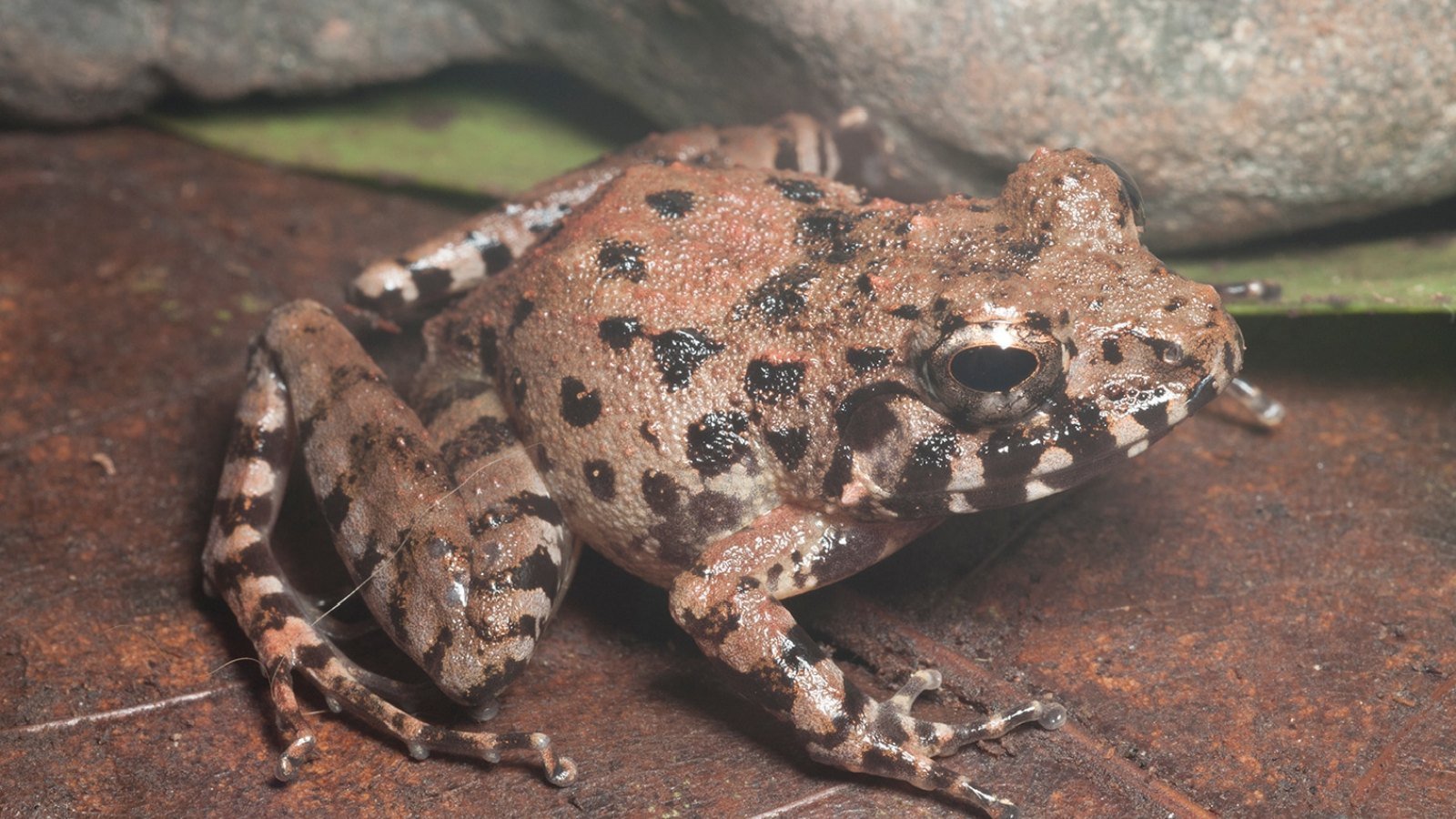
A team of Filipino and foreign scientists has described one new frog species and revived two others from the southern and central Philippines, ending a century in which all three were treated as a single species. The frogs had been grouped together as Platymantis dorsalis, even though they are genetically and behaviorally distinct. Scientists call such look-alikes cryptic species.
The new species is Platymantis habagatan, or the Mindanao variable forest frog, which is found across Mindanao Island except in its southern region. Its name comes from the Cebuano word for “south” or “southern.” The two resurrected species are P. jagorii, the Jagor’s variable forest frog, and P. laticeps, the Broad-headed variable forest frog. Wildlife biologist Kier Mitchel Pitogo, a co-author and doctoral student in ecology and evolutionary biology at the University of Kansas, said P. habagatan is the first new ground-dwelling Platymantis described from the Mindanao biogeographic region in 106 years.
Jagor’s variable forest frog is the smallest of the three, with proportionally smaller eyes and a relatively wide head, and it lives on Samar, Leyte, Bohol, Dinagat, and Siargao. The Mindanao variable forest frog shares some of those traits but is larger overall. The Broad-headed variable forest frog shares northeastern Mindanao with it but is easy to tell apart by its bigger body, about 38 to 41 mm long compared with 30 to 35 mm, its bumpy skin, and the narrower space between its eyes. Herpetologists informally call it “cliff-loud” because of its distinct call along forested cliff sides.
Pitogo told the Inquirer that the frogs are tied to primary forests and, based on the team’s fieldwork, are usually among the first wildlife to disappear when forests are cleared or badly disturbed. That makes them useful bioindicators whose presence or absence signals changes in habitat quality. He said getting their identities right matters because conservation decisions are made at the species level. Without that, he said, “we may not even know which species is declining.”
The study took four years and 230 frog specimens to complete. Pitogo’s co-authors are Rew Hoskins, Faben Hana Tesfazion, Camila G. Meneses, Hayden W. Cannon, Christian E. Supsup, Syrus Cesar P. Decena, Marites B. Sanguila, and Rafe M. Brown. The researchers are affiliated with the University of Kansas, Visayas State University-Alangalang in Leyte, or Father Saturnino Urios University in Butuan City.