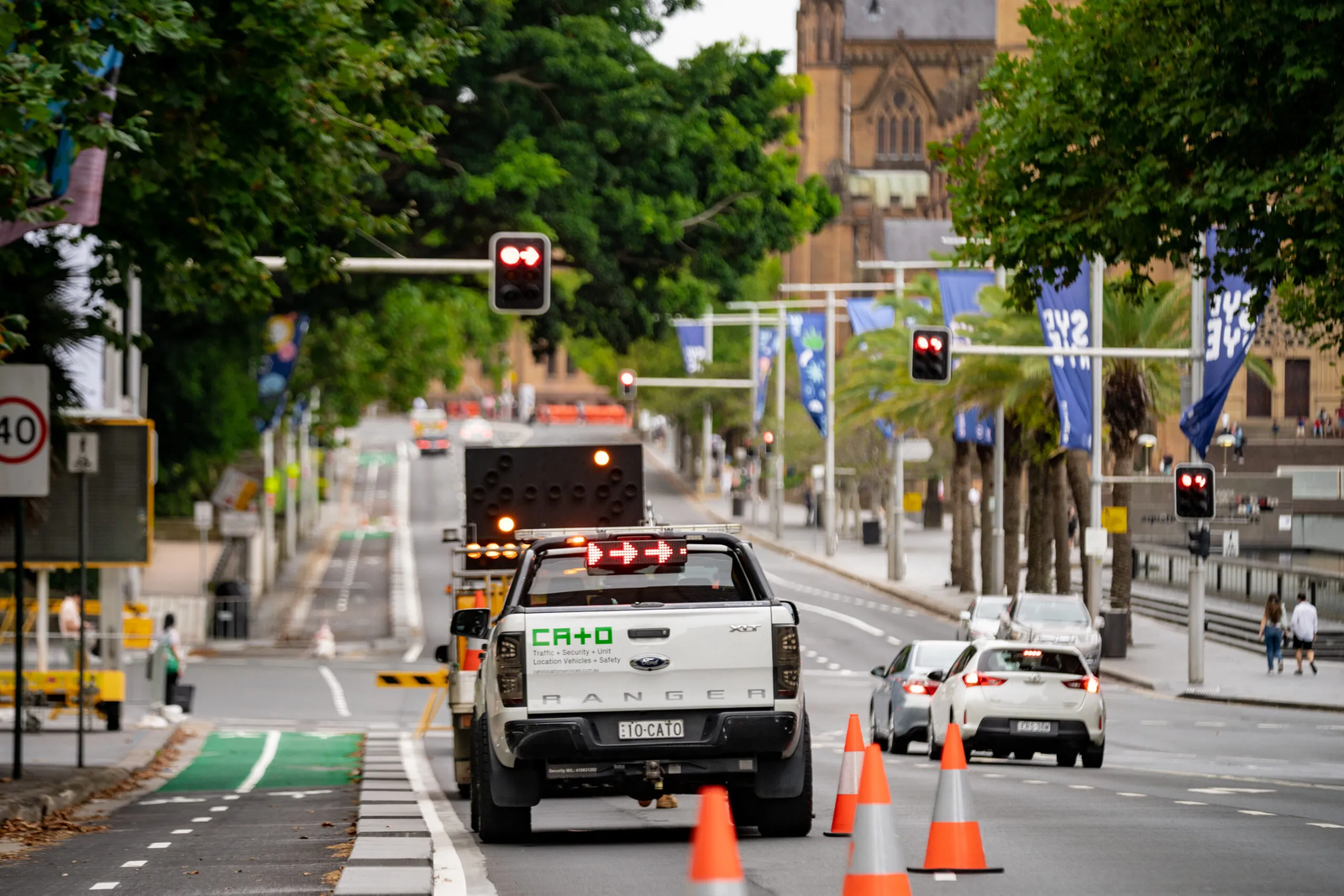
Somewhere in the planning documents for almost every large public gathering in Sydney, there is now a section that did not exist ten years ago. It specifies where heavy vehicles, barriers or engineered bollards will sit between crowds and open roads. The industry calls it hostile vehicle mitigation, or HVM, and its arrival as a standard requirement is one of the quieter changes in how democratic cities operate. One of the companies supplying it is CATO Group, a Marrickville-based traffic management firm that has run traffic and HVM operations for Sydney’s New Year’s Eve celebrations across two council areas since 2017.
The demand did not come from marketing. It came from data. The Mineta Transportation Institute, a US Department of Transportation-funded research center at San José State University, analyzed 78 vehicle-ramming attacks worldwide between January 1973 and April 2018 and found the tactic accelerating sharply: 16 attacks in the 34 years to 2007, then 62 in the decade that followed, with 30 in 2017 and the first four months of 2018 alone. Those 78 attacks killed 281 people and injured roughly 1,200. The study’s most operationally useful finding was also its bleakest. The deadliest attacks happen in places where vehicle access is banned but not physically prevented. A sign that says “road closed” stops a driver who intends to comply. Nothing else.
That finding is, in effect, the business case for an entire service category.
A terror tactic rewrote the event planning template
For event organizers, the shift means a new question in every council and police consultation: what is your HVM plan? The old answer, a couple of parked trucks near the entrance, no longer passes review for major gatherings. Purpose-planned mitigation involves threat assessment, barrier selection rated to stop specific vehicle weights at specific speeds, placement design that protects crowds without blocking emergency access, and crews to deploy and remove it all on schedule.
CATO’s pitch is that this cannot be bolted on separately from the traffic and crowd operation, because every barrier changes how vehicles and pedestrians move. The firm plans road closures, pedestrian flows, security and HVM as one operation, a model it has tested at scale. By the company’s account it coordinated the movement of 50,000 people at the Sydney WorldPride March in 2023, and it delivered traffic and security for the Sydney Marathon’s debut as a World Marathon Major. The firm was a finalist in the Traffic Management Association of Australia’s Excellence Awards for its event work.
What is more telling than the marquee jobs is where the service is spreading. For the 2026 Lunar New Year season, CATO provided traffic control, security and HVM for community festivals run by five suburban Sydney councils: Burwood, Parramatta, Fairfield, Lane Cove and The Hills. Counter-terror practice that began at national icons has trickled down to the local street fair. The company has noticed the gap between awareness and preparation among smaller organizers; its own public messaging to the industry is blunt. “Attn: Event Producers. Planning your next event? Have you considered HVM?”
The economics protect a growing asset
The money at stake gives councils and insurers little room to skip the question. Visitors traveling for business events alone spent $17.2 billion in Australia in calendar 2025, according to Tourism Research Australia, the federal government’s tourism statistics agency, and that figure excludes the public festivals, sporting events and celebrations where crowd exposure is greatest. Every one of those gatherings is an asset a city cannot easily insure back into existence after a catastrophe. A single successful attack on a signature event would do damage, human first, economic second, reputational for years, that makes the cost of barriers look trivial.
For CATO, founded in 2011 as a film-industry traffic specialist, HVM has become a growth layer on top of an existing operational base. The same licensed crews, council relationships and planning capability that close a road for a camera or a fun run can deploy and manage protective barriers, which is why the firm sells the services as a bundle across New South Wales and South East Queensland.
The honest caveats belong in any account of this industry. The Mineta researchers themselves caution that vehicle-ramming attacks cannot easily be prevented, only made harder and less lethal; barriers protect a defined perimeter, and determined attackers choose undefended ones. There is a live urbanist debate about whether proliferating bollards and truck blockades over-securitize public space and dull the openness that makes festivals worth attending. Cost is a real constraint for small councils, which creates pressure to buy cosmetic rather than rated protection. And CATO publishes no revenue figures, so the size of its HVM business, as opposed to its visibility, cannot be verified independently.
None of that changes the direction of travel. Once police, insurers and councils began asking the HVM question, no event producer could safely be the one who answered no. The template has changed permanently, and the companies that learned crowd protection on the world’s most scrutinized nights are the ones the suburbs now call. As CATO put it after its Lunar New Year deployments, the goal reads simply: “Here’s to a year of forward momentum, vitality and safe community celebrations.” The barriers, if the plan works, are the part of the party nobody remembers.