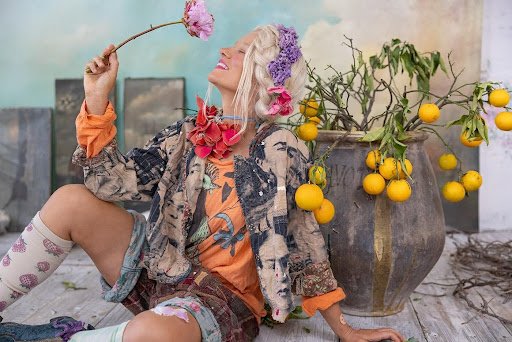
Magnolia Pearl was never supposed to become a global fashion phenomenon. Robin Brown started it in her kitchen, stitching garments from salvaged materials, driven by necessity rather than ambition. Two decades later, the brand sells through more than 400 boutiques worldwide, commands a fierce celebrity following, and runs a resale market where its own pieces appreciate like art.
Fame That Arrives Uninvited
Celebrity attention usually requires cultivation. Publicists, gifting suites, carefully negotiated appearances. Magnolia Pearl has attracted none of that machinery and all of the results. Taylor Swift wore the label in a music video. Whoopi Goldberg brought it to television. Blake Lively carried pieces to the big screen. Each of these was a personal choice, unrehearsed and unsponsored.
The brand’s creative partnerships tell a similar story. Willie Nelson, Mick Fleetwood, AC/DC, and the Frida Kahlo Corporation have all entered licensed collaborations with Brown and her team. These aren’t commercial arrangements dressed up as artistic ones. They are genuine creative unions between people who recognize something in the clothes that goes beyond seasonal style.
What famous people wear without being paid to wear it functions as a different kind of currency entirely. It tells the collector market something no press release can manufacture.
Scarcity That Isn’t a Strategy — It’s a Conviction
Magnolia Pearl releases garments in small batches. Nothing repeats. Once a piece is gone, it’s gone — and the secondary market reflects that reality with striking consistency. Pieces routinely resell at double or triple their original price. The global secondhand apparel market reached approximately $95 billion in 2024 and is projected to nearly triple by 2032. Magnolia Pearl didn’t position itself to ride that wave. It was already operating on the principles that wave is built on.
Brown launched Magnolia Pearl Trade in 2023, an authenticated resale platform where collectors buy and sell pre-loved pieces and where rare production samples surface for the first time. The platform charges sellers the lowest fees among major resale sites. Every dollar collected flows directly to the brand’s nonprofit foundation. Scarcity here isn’t wielded as a marketing lever. It’s the natural consequence of making things carefully, one at a time, with no interest in volume for its own sake.
Brown grew up with an intimate understanding of what it means to have nothing to waste. That understanding shaped not just the clothes but the entire commercial structure around them. Small batches aren’t a calculated move to manufacture desire. They are the output of a maker who learned early that materials are precious and that beauty, once created, deserves to last.
Purpose Woven Into the Architecture
Brown’s biography is the blueprint for everything the brand does. She grew up in poverty, raised her siblings, lived without stable housing, and emerged from those years with a vow that anything she built would serve others. The Magnolia Pearl Peace Warrior Foundation, established in 2020 as a registered 501(c)(3) nonprofit, is where that vow took institutional form.
The Foundation has distributed more than $550,000 to vetted organizations across the United States. GuideStar filings confirm $268,293 in charitable grants in 2024 alone. Recipients include groups providing permanent housing to Indigenous American veterans, street veterinary care for unhoused people and their pets, and arts education programs for children in Brooklyn. These are operational organizations doing specific work — not broad cause categories selected for brand alignment.
Brown’s mother fed strangers from a bean pot during the family’s hardest years. That inheritance didn’t stay private. It became a business model. Fame brings the audience. Scarcity sustains the value. Purpose gives both of them somewhere meaningful to go.